Latest update: May 18, 2026 - 5 min read
Using a Personal Vehicle for Work in Canada
If you drive your own car for work in Canada, you can use your personal car for business, and usually have a way to get reimbursed for it. How that works depends on whether you’re an employee or self-employed.
Employees can be reimbursed by their employer (either a per-kilometre allowance using the CRA mileage rate, or a flat car allowance) or claim certain unreimbursed expenses on their tax return.
Self-employed people deduct the business-use portion of their vehicle expenses directly from their business income.
There’s also one thing many people miss: standard personal auto insurance doesn’t automatically cover driving for work. Here’s how all of it fits together.
Personal use vs. business use of a vehicle
According to the Canada Revenue Agency (CRA), there are two different reasons you would drive a vehicle: personal use and business use.
- Personal use: You’re driving the car for non-employment activities, such as attending personal activities, going on vacations, or travelling between home and a regular place of employment (such as an office, store, or construction site where you regularly report to work).
- Business use: You’re driving the car to perform employment duties, such as transporting goods, attending a conference or business meeting, visiting a client, or visiting other work locations that’s not your regular workplace.
Tax implications for using your car for business
You may be eligible for certain tax deductions if you drive your vehicle for work-related activities. Exactly what you can claim depends on your employment situation.
If you’re an employee
All employees:
- Can claim expenses related to driving their vehicle for business purposes.
- Cannot claim expenses related to personal use.
- Cannot claim any vehicle expenses if your employer reimburses you.
- If you receive a flat-rate allowance from your employer, it’s a taxable benefit.
- Have a log that keeps track of all the kilometres you drove and the kilometres you drove for work purposes.
- If you have more than one car that you use to earn income, you’ll need to calculate the expenses for each of them individually.
Salaried employees:
You can claim motor vehicle expenses if you meet all of the requirements:
- You’re required to work at locations other than your regular workplace.
- You pay for car expenses that aren’t reimbursed, as stated in your contract.
- You receive a regular paycheque based on your salary.
- You did not receive a non-taxable (reasonable per-kilometre rate) allowance.
- You have a record of the Form T2200, Declaration of Conditions of Employment filled out by your employer.
Commission employees:
- You can claim vehicle expenses if you meet all of the conditions:
- You work at locations other than your regular workplace.
- In your contract, you have to pay out-of-pocket for car expenses that aren’t reimbursed.
- You have a commission-based job, which is based on your sales or contracts signed.
- You did not receive a non-taxable allowance, such as a reasonable-kilometre rate.
- You have a record of Form T2200, Declaration of Conditions of Employment filled out by your employer.
How to deduct vehicle expenses on your tax return
Step 1: On Form T777, Statement of Employment Expenses, you’ll need to add your vehicle expenses in the section “Line 3 - Calculation of Allowable Motor Vehicle Expenses.”
You’ll be required to enter the following information:
- Year, make and model of your car
- Formula: kilometres driven to earn income ÷ total kilometres driven = % you can claim
Then, you’ll enter your vehicle expenses:
- Fuel
- Maintenance and repairs
- Insurance
- License and registration
- Capital cost allowance
- Interest expense
- Leasing costs
- Other expenses
You’ll calculate the total and multiply it by the percentage you can claim.
If you have any rebates or reimbursements, you’ll need to deduct these from your expenses to determine the total amount of vehicle expenses (line 32).
Step 2: Take the amount from the total expenses (line 32) on Form T777 and enter it on line 22900 of your tax return.
If you’re self-employed
If you use your vehicle for business and personal use, you can claim the portion of vehicle expenses related to business use. The exception to this rule is that you can claim the full amount of parking fees and business insurance.
How to deduct vehicle expenses on your tax return
Sole-proprietors: On Form T2125, Statement of Business or Professional Activities, you can calculate the total vehicle expenses in “Chart A – Motor vehicle expenses.”
You’ll need to record the kilometres you drove for business purposes and the total number of kilometres you drove the car. This will determine the percentage of vehicle expenses you can claim. Fuel, insurance, maintenance and repairs are expenses you can deduct.
You can find more details in our guide on claiming motor vehicle expenses from the CRA.
Partnerships: You can claim vehicle expenses through the business use of your personal vehicle on Form T2125 in Part 6 “Other amounts deductible from your share of net partnership income (loss).” Ensure you’re only claiming expenses that aren’t reimbursed by the partnership.
Records you need to keep
Regardless of your employment situation, you must keep a detailed mileage log when driving your car. This way, if the CRA asks you for this information, you can provide it to them. Keep the receipts of any vehicle expenses so you can claim them on your tax return.
Does using your personal vehicle for work affect your insurance?
Yes, often. Standard personal auto insurance in Canada generally covers commuting to a regular workplace, but it doesn’t automatically cover driving as part of your job. Using your personal vehicle for work without telling your insurer can mean a claim is denied, even if the accident has nothing to do with work driving.
Personal vs business auto insurance policy
A standard personal auto policy will usually cover:
- Commuting between home and a regular place of work
- Occasional, incidental work errands (this varies by insurer)
What it typically doesn’t cover without a “business use” endorsement:
- Visiting clients, customers, or job sites during the workday
- Transporting tools, equipment, or goods for work
- Driving between multiple work locations
- Rideshare or delivery driving (these usually need a specific rideshare or commercial policy)
Who is responsible for insuring the car?
The vehicle owner is the policyholder, so if you own the car, you’re the one who needs to make sure the coverage matches how you use it.
Some employers carry “non-owned auto” liability insurance — but that policy protects the employer, not you and not your vehicle.
Tip: Before you start using your personal vehicle for work regularly, check your policy and call your insurer if anything’s unclear. It’s a 10-minute conversation that can prevent a denied claim later.
FAQ
Yes. Employees can be reimbursed by their employer or claim unreimbursed expenses on their tax return. Self-employed people can deduct the business-use portion of their vehicle expenses directly. In both cases, you need a mileage log.
Driving from home to a regular workplace is personal use — even if you're driving to a job site you visit every day. Driving to a one-off meeting, client visit, or alternate work location is business use.
Often, no. Insurers can deny claims if the vehicle was being used for a purpose not declared on the policy. Always check with your insurer before relying on personal coverage for work driving.
If your employer reimburses you, the rate is at their discretion (commonly aligned with the CRA reasonable rate). If you claim unreimbursed expenses on your tax return, you claim a percentage of your actual vehicle expenses based on business-use kilometres — not a flat per-km rate.
Generally, no. If your allowance is non-taxable (based on a reasonable per-kilometre rate), you can't also claim vehicle expenses. If the allowance is taxable (e.g. a flat monthly amount), you may be able to claim expenses — see the conditions in the section above.
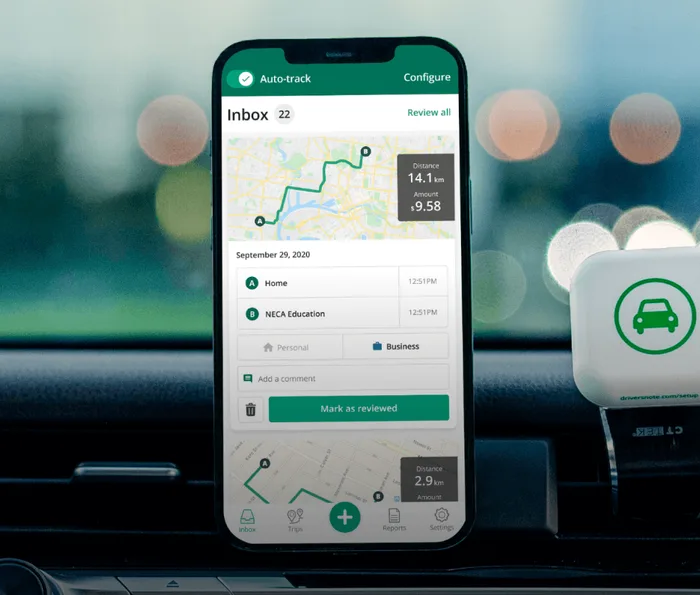
Tired of logging mileage by hand?
Effortless. IRS-compliant. Liberating.
 Auto-track trips
 Classify trips
 IRS compliant reports