![Income & Expenses Spreadsheet for Small Businesses [Free Download]](/_marketing/images/content/blog/income-and-expenses-spreadsheet-small-business-template-free-download/income-expenses-spreadsheet-template-canada.svg)
Latest update: March 18, 2026 - 2 min read
Income and Expenses Spreadsheet for Small Business 2026 [FREE]
For small business owners and self-employed, keeping track of cash inflows and outflows can be easy with an income & expense worksheet. It provides a clear financial picture of where your money’s going, what categories you spend it on, and when you spend it. Recording your income and expenses manually in a spreadsheet or on paper can be time-consuming. To save you time and help you focus on your business, we’ve prepared a free Google Sheets income and expense template—no sign-up is needed.
Download the small business spreadsheet for income and expenses [Google Sheets, Excel]
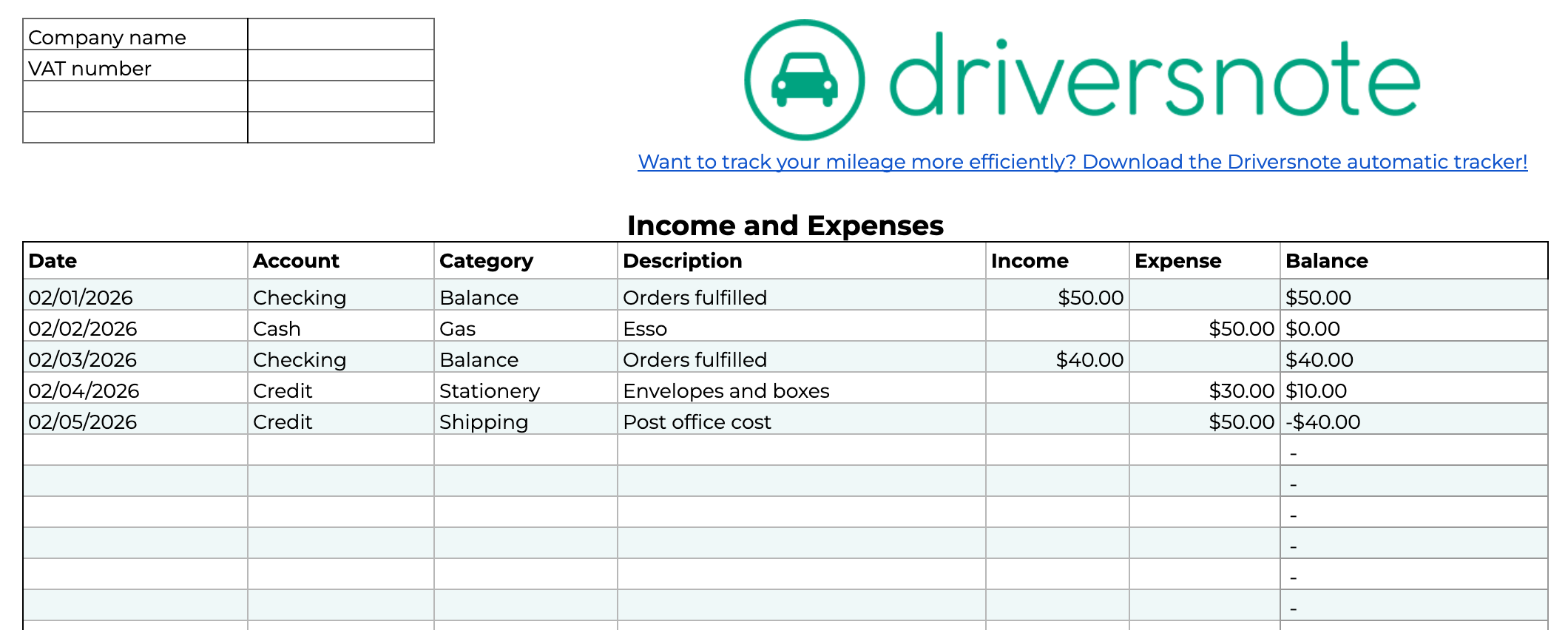
The income and expenditure spreadsheet for small businesses is available in Excel and Google Sheet formats. You can download it onto your phone or laptop—wherever you prefer to log your transactions.
If you wish to keep a physical record, you can print the template and fill it out by hand. Once you’ve downloaded your preferred format, you can enter your numbers in the template.
How to fill out the spreadsheet
Here are the steps you can follow:
- You enter the date, type of account (chequing, credit, cash, or other), the category (type of income or expense), the description, and the transaction amount. The ‘balance’ column at the end automatically populates for each row. It will let you know if you have a positive or negative balance at the end of each month, quarter, or year.
- Once you’ve entered the data for a specific period, you can use that file as a basis for the following period. You can always add more rows for any new expenses or income sources.
- Make sure you record accurate numbers for each transaction, as you may use them to claim tax credits or deductions when you file your tax return.
- If you use business expenses to reduce your taxable income, keep your receipts as supporting documents for six years for potential Canada Revenue Agency (CRA) audits.
When to fill out the spreadsheet
When you incur one-time or recurring expenses, you can record them in the template. You can do the same to record your income. This way, you can keep a timely record of your cash inflows and outflows and maintain your accounting books.
If you don’t update the spreadsheet daily, weekly, monthly, or quarterly, you can do so toward the end of the year. Ensure you keep your receipts and bank statements handy when filling out the spreadsheet.
Tax-deductible expenses
Generally, any expenses incurred for business purposes are tax-deductible and can be used to lower your taxable income. Some commonly deductible business expenses include:
- Start-up costs
- Vehicle expenses
- Insurance
- Maintenance costs
- Mobile phone and internet costs
- Office expenses
- Advertising
- Meals and entertainment (50% of the cost)
- Capital cost allowance (CCA)
- Property tax
- Interest fees
GST/HST requirements
If you collect Goods and Service Tax (GST) or Harmonized Service Tax (HST), you’re required to remit them to the CRA based on your reporting period. However, you can reduce the tax payable amount by using your GST/HST input tax credits (ITCs), which refer to the taxes your business has paid on goods and services.
Also read: GST/HST Guide for Self-Employed and Small Businesses
Tips for managing your income and expenses spreadsheet
Here are some effective ways to manage your spreadsheet. By implementing these strategies, you’ll gain a better understanding of how your business is operating financially:
- Maintain invoices and receipts to better track your income and expenses.
- Organize your receipts and invoices by category.
- Highlight any business expenses that can be claimed as tax credits.
- Double-check the numbers in your template for accuracy.
- Set a budget and analyze your spreadsheet to see if you exceeded or stayed within those budget constraints.
- Check whether any adjustments are needed going forward.
- Identify your spending trends for each month and compare them with prior months to see if they align with your financial goals.
FAQ
Maintaining an income and expense worksheet provides a clear financial picture of your small business. It highlights which areas you spend money on and which ones generate income. It also helps you take advantage of deductions when filing your taxes.
Of course! You can use your income and expense spreadsheet to make the most out of your tax deductions and maintain expense receipts to support them.
Many websites offer a monthly income and expense Excel sheet. You can download a free template from Driversnote without signing up or registering for an account.

Tired of logging mileage by hand?
Effortless. IRS-compliant. Liberating.
 Auto-track trips
 Classify trips
 IRS compliant reports